Watching the World Cup, I’m often struck by the degree to which some teams display a level of collective play that seems to surpass others, who appear more disconnected from each other, relying more on individual brilliance.
Of course, sometimes individual brilliance is enough.
But more often, the more team-focused approach prevails.
This is particularly true with nonprofit organizations.
Too often I’ve seen Executive Directors of small to medium sized organizations (think 4-15 staff) who fail to create systems and a culture that emphasizes teamwork. Work gets done, and often well. But opportunities are missed and the organization’s success is brittle, more likely to be set back when there’s staff turnover.
Why is teamwork so critical to success? And what systems can you put in place to put teamwork front and center?
Let’s start with a true story from my consulting experience.
An Executive Director I knew launched a new fundraising event for a small organization that had been around quite a few years. I asked: “Are you using an Event Committee to recruit event and table sponsors?” Their reply: “I decided it would take more work calling and arranging meetings of the committee, so I’ll instead just work with individual volunteers one-on-one to enlist their help.”
Two months later the same Executive Director complained to me they were doing all the work recruiting sponsors as the volunteers weren’t coming through.
I wasn’t surprised.
Effective leaders create a shared vision and rally people around achieving that vision via a team mentality.
While leaders can recruit and engage volunteers one-on-one (and should!), the magic of teamwork requires some number of people more than two.
While my example focused on volunteers, the same is true with regards to staff.
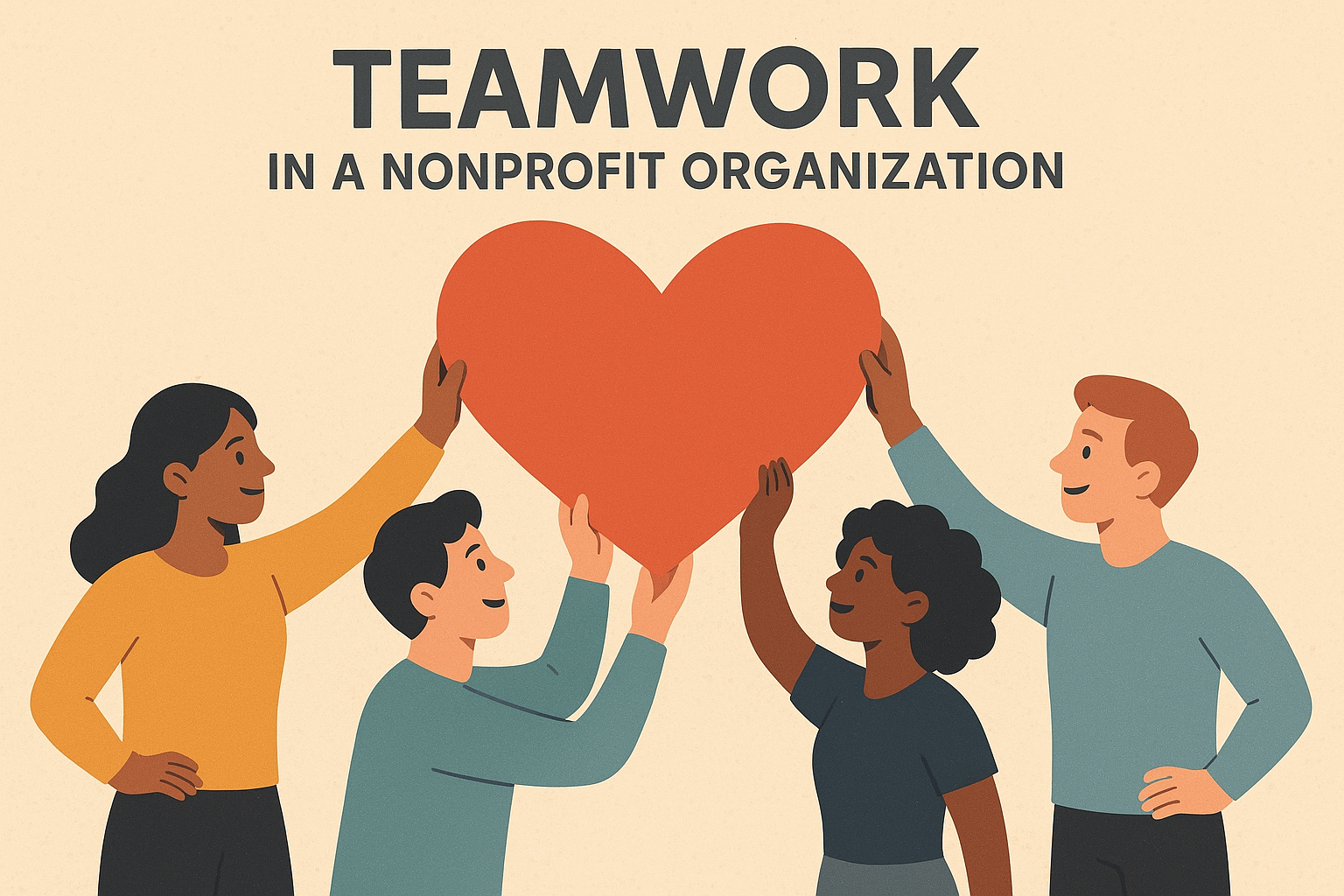
Teamwork in a well-run meeting has some clear benefits.
For starters, individuals feed off of each other’s ideas. In the fundraising event example, if John mentions a potential table sponsor during a meeting (“Sam Jones would be a great person to ask”), it often will trigger ideas of other potential sponsors (“Sam is friends with Rachel, and she can do her own table”) from those around the table that just won’t be generated via one-on-one conversations with the Executive Director.
Having all the conversations happen with the Executive Director as hub and individual board and volunteers (or staff) as spokes on a wheel limits idea-generation to interactions with the Executive Director.
Beyond ideas, individuals also feed off each other’s energy. If there is an upbeat, positive orientation to the meeting (“together, we’re going to put on a great event!”), that energy is often contagious in a way that can’t be duplicated in one-on-one conversations.
Individuals also hold each other accountable to the team. If one person commits in a conversation with the Executive Director to do something, they may be willing to face the consequence of having to tell them two weeks later that they haven’t gotten around to it.
It becomes harder if they’ve made the commitment in a meeting in front of a half-dozen others and they know they’ll have to report back on progress to the whole team. Time and again, I’ve found higher degrees of follow-through by volunteers and staff when commitments are taken on in meetings where their peers are present.
There’s one more aspect worth noting: think of personal relationships among individuals involved with an organization as a series of strands making up a spider web Do you ever see a spider web that’s just a spoke and a series of links outward?
Like with a spider, a teamwork approach yields a stronger web by creating bonds not just between the Executive Director and others, but between other staff and/or volunteers.
The value of relationships as an organizational asset multiplies dramatically when staff and volunteers have relationships with each other and perceive themselves as part of something bigger than themselves.
In Why Organizations Thrive Lesson 15: Give Away Your Power, I advised organizations to pay attention to what Jim Collins refers to as “Level 5 Leadership.” Level 5 Leaders exercise legislative power more than executive – building a shared vision via persuasion and effective decision-making processes rather than via executive fiat. By being willing to risk a wrong decision sometimes being made via a more collaborative approach, the Level 5 Leader builds teamwork that generates benefits that far outweigh the risks and costs.
Of course, it’s easy to say: “focus on the team,” but what does that mean in practice.
Books have been written on the subject, of course.
For me, I’d focus first and foremost on five things:
- Commit to spending an adequate amount of time in meetings focused on the substantive work of the organization in which real, substantive work is discussed, planned for, and set in motion.
- Find opportunities to have multiple staff (or volunteers) work together on events or activities, even if that means bending job descriptions.
- Set a clear example in which you as the leader are open to internal conflict (expressed in legitimate ways) so that substantive disagreements aren’t masked.
- Hold low performers accountable – particularly those who aren’t even trying. I’ve repeatedly seen the tolerance of low performers negatively impact the morale of others on the team, undercutting their performance in turn.
- Focus discussions on collective outcome more than individual performance. Celebrate collective successes and take steps to collectively learn from poor outcomes.
As a question of process, as an Executive Director I’d set aside an hour every month where you explicitly ask yourself: how has my work recently contributed to teamwork within the organization? Are we putting in the time, finding opportunities for staff to work together, and creating a team-first culture? What more should be done in the next month or two to emphasize teamwork in our approach?
Of course, you can take the search for teamwork too far. I’ve seen an Executive Director lean so heavily towards collaboration that it prevented efficient decision-making, paralyzing the group from action. But I’ve seen collaborative paralysis FAR less frequently than Executive Directors who fail to emphasize the team.
Leave a Reply