
More than a decade ago, I reviewed the book the Effective Executive, by Peter Drucker. It’s a classic first published in 1967.
It’s rather dated. It was particularly amusing to read what Drucker wrote in 1967 about the expected impact of computers on executives.
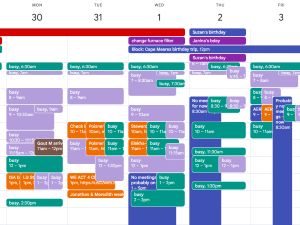
Yet, in other ways Drucker’s book remains timeless. I was recently prompted to re-read his section on meetings. I’ve encountered several recent examples of executives who struggle to get work done because meetings take up such a high percentage of their time. I wondered what wisdom Drucker offered.
After all, time is your most precious resource as an executive. With the help of Drucker and others, I’ve identified some tips any executive should consider.
These tips are all designed to serve at least one of three purposes.
- Limit the number of meetings you attend.
- Make the meetings you do attend shorter
- Make the meetings more effective in ways that limit the need for follow-up meetings.
My top seven tips for How to Participate in Fewer, Shorter, and/or More Effective Meetings
1. Perhaps the most obvious solution is to delegate somebody else to attend.
Is there somebody else who can effectively serve your role in this meeting, particularly with external partners/allies? This isn’t a question of whether they will be equally effective. It’s a question of whether they will be a reasonably effective stand-in.
Bonus: In addition to saving you time, it may be a useful professional development opportunity for whoever is sent in your place.
2. Reject meeting requests where you’re the icing on the cake.
When getting a meeting request – particularly with external partners, ask: am I essential or just icing on the cake? Do I have essential information that can only be conveyed during the meeting, not ahead of time? Is it a decision-making meeting where I’m the decider (or one of them) and must attend to weigh in effectively? Is my participation essential for some other reason? If the answer is no to all three questions, decline to participate.
3. Reject meetings without a clear purpose that can’t be achieved in other ways
Don’t ask for a meeting if you can’t succinctly explain its primary purpose. Ask for the same when getting meeting requests.
Ask yourself: could we accomplish the same thing more effectively simply by communicating asynchronously in some other way, whether it’s an online project management system, email, or otherwise?
This is especially true with staff meetings for small to mid-sized nonprofits. If the purpose is to simply share with each other what’s happening with various programs, could most of that be accomplished by asking everyone to share the information ahead of time and only meet if people have questions/concerns.
4. Slow the cadence of recurring meetings
On several occasions I’ve advised boards through the process of moving from monthly to every-other-month meetings, in part out of concern for the demands board meetings place on executives.
With staff oversight, instead of a 45-60 minute weekly one-on-one, consider a 60-75 minute one-on-one every other week.
5. Shorten meetings
It’s not technically “fewer meetings,” but the overall amount of time in meetings can be reduced by simply making them shorter. Don’t default to 60 minute meetings when 30 or 45 will do if they are run efficiently.
Of course, that requires active facilitation taking into account the time limitations.
And stick with those time limitations. A close friend was recently complaining to me about how a 60 minute meeting that went on for more than 100 minutes, with a lot of meandering conversation that was repetitive or off-topic. Speak up if you find this happening.
If you find yourself with a “culprit” who repeatedly forces you into meetings that go long due to poor facilitation, schedule something else (or pretend to have done so) on your calendar for immediately after the stated end-time. Communicate this “hard stop” up-front as the meeting commences. Don’t waver.
6. Make the meeting close more effective
Over the years, I’ve sometimes been forced into meetings necessitated only because the prior meeting on the same topic failed to be explicit regarding who was doing what by when. Since things were fuzzy, another meeting was required.
Assign a notetaker and make sure action items/to-dos are distributed within 24 hours of any meeting.
Then use email or other internal communications to track peoples activities in response. Only meet again on the same topic if it proves necessary.
7. Block non-meeting time in your calendar
If the above tactics haven’t work and something important keeps getting triaged from your to-do list, consider scheduling blocked time in your calendar that is labeled as “No Meetings” where you can focus on specific, important, recurring tasks.
Hold those times sacrosanct.
=======================================================
What did I leave out of the above list? Have you successfully used additional tactics to limit the challenge of attending too many meetings?
Leave a Reply